CAP Theorem: One of the Most Misunderstood Concepts
Before talking about the CAP theorem, we first need to understand what Consistency, Availability, and Network Partition actually mean.
Let's say we have a cluster of servers. A server, or node, is simply a machine running our application. These servers are usually distributed across different parts of the world, and they communicate with each other over the internet.
Now imagine something goes wrong. A cable gets cut, a router fails, or an entire region experiences network issues. The servers themselves are still running, but some of them can no longer communicate with the others.
This is called a network partition.
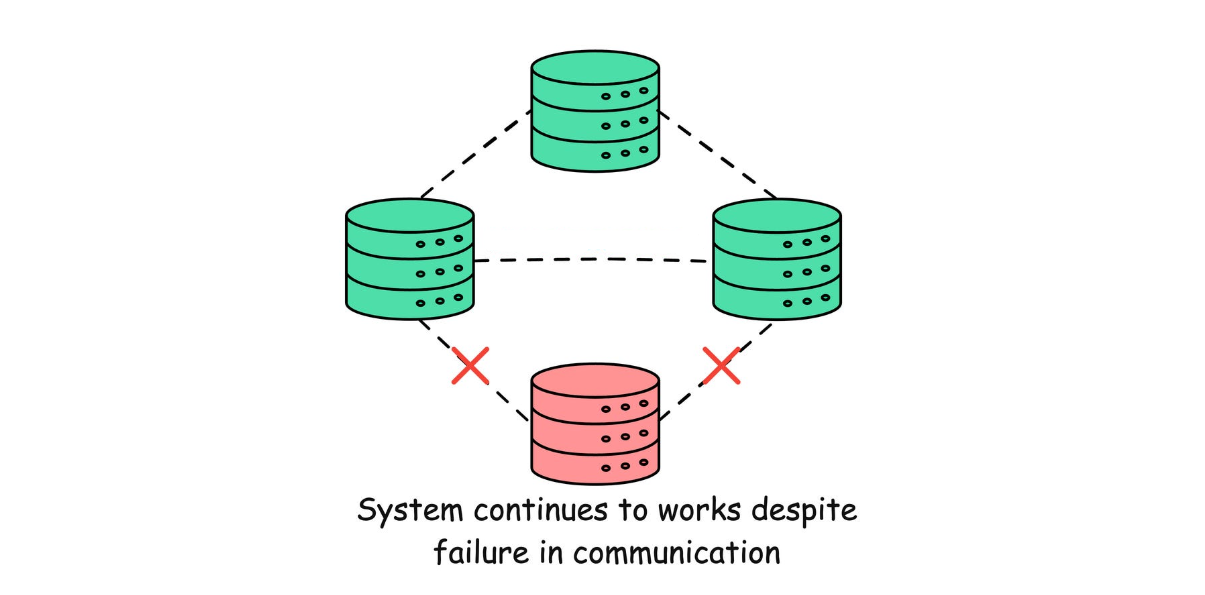
The server isn't necessarily down — it's still running. It's just isolated from the rest of the cluster.
Why Partition Tolerance is the Default
People often assume we choose all three properties in the CAP theorem. But in practice, we almost always get Partition Tolerance by default.
Why? Because network failures are an unavoidable reality of distributed systems. We cannot prevent cables from breaking or packets from being lost. When building a distributed system, we must accept that a partition will happen at some point.
So Partition Tolerance isn't really a choice we make — it's a constraint we operate within.
The real decision is between Consistency and Availability.
Both When Things Are Healthy
If the network is operating normally and all servers can communicate with each other, we can be both consistent and available simultaneously.
The CAP theorem only becomes meaningful when a network partition occurs.
What Happens During a Partition
Imagine one server gets isolated from the rest of the cluster. The remaining servers are still connected to each other, so they continue serving users normally.
Now suppose a user uploads a new post. The healthy servers receive that update immediately. The isolated server does not.
A short time later, the network recovers and the isolated server rejoins the cluster.
Now imagine two users open the application at the exact same moment:
- One user connects to an up-to-date server and sees the latest content.
- The other user connects to the server that was isolated and sees older data.
The data is now inconsistent — different servers are returning different results to different users.
The Choice: Consistency or Availability
This is exactly where the CAP theorem forces a design decision.
Option A — Choose Consistency
As soon as a partition occurs, stop serving requests that could return inconsistent data. Users may need to wait until the isolated server catches up and synchronizes.
- Data is always correct and up to date
- Parts of the application become temporarily unavailable
Option B — Choose Availability
Every server continues responding to users even during the partition.
- Users always receive a response
- Some users may receive stale or outdated data until everything synchronizes
CAP Is Not a One-Size-Fits-All Decision
Here's something beginners often misunderstand: CAP isn't saying you permanently choose one side for your entire application.
Real-world systems make different trade-offs for different components.
Consider a banking application as an example. A bank isn't a single monolithic service — it has account management, transaction processing, balance inquiries, notifications, audit logs, and many other components. Would we apply the same CAP trade-off to all of them? No.
| Component | Preferred Trade-off | Reason |
|---|---|---|
| Notifications / alerts | Availability | A slightly delayed notification is acceptable |
| Balance inquiries | Consistency | Users must see their accurate balance at all times |
| Payment processing | Consistency | A transaction must never be counted twice or missed |
| Fraud detection | Consistency | Decisions must be based on the most current data |
Imagine a user initiates a wire transfer. The transaction succeeds on one server, but due to a partition, another server has no record of it. That discrepancy could result in duplicate charges, overdrafts, or regulatory violations — all serious issues in a financial context.
For this reason, payment and transaction systems are almost always designed to favor Consistency over Availability.
What About a Single Server?
If you only have one server, the CAP theorem doesn't really apply.
There are no multiple servers communicating over a network, so there is no possibility of a network partition between replicas. A single server can provide consistent data and high availability — as long as the server itself remains operational.
The limitation is scalability. Eventually, a single machine will reach its limits in terms of CPU, memory, storage, or network bandwidth. That's when we distribute the system across multiple servers — and that's exactly when the CAP theorem becomes relevant.
Summary
| Scenario | What You Get |
|---|---|
| No network partition | Both Consistency and Availability |
| Partition occurs, you choose Consistency | Correct data, reduced availability |
| Partition occurs, you choose Availability | Full availability, possible stale data |
When there is no network partition, both properties can coexist. When a partition inevitably occurs, the design of each service component should determine which property takes priority.
That is the CAP theorem in practice.